
sikhchic.com
By: T. SHER SINGH
September 22, 2014
This is the third in the series [The Extraordinaries]
There are a couple of my own self-imposed rules I am breaking today as I write this piece on the next personage I wish to introduce to you as part of a series titled, The Extraordinaries.
First of all, here at sikhchic.com we try to avoid showcasing those who are closely associated with our operations. The only reason is to steer away from using the online magazine to ' blow our own trumpet' — that is, to promote ourselves in any way.
My subject today is a Founder-Patron of sikhchic.com.
The second self-imposed rule I' d be breaking today is because he also happens to be a dear friend who has worked closely with me for the last two decades on many of the projects closest to my heart. Both his guidance and support have been integral to their success. The rule being broken is that I have, throughout my life and at the expense of my near and dear ones, tried to avoid even a semblance of nepotism. When I do write about them, the sole intention is to spell out their role in a history, but not to gush over them.
Why am I breaking these rules today, then?
As I grow older, I am beginning to dread waking up one morning to find I' m dead, and have moved on to an after-life without having told the world how much this project — sikhchic.com — which so many of you love as much as I do, exists because of the foresight, guidance and largesse of one extraordinary man. It would be an unforgivable crime on my part to not tell his story.
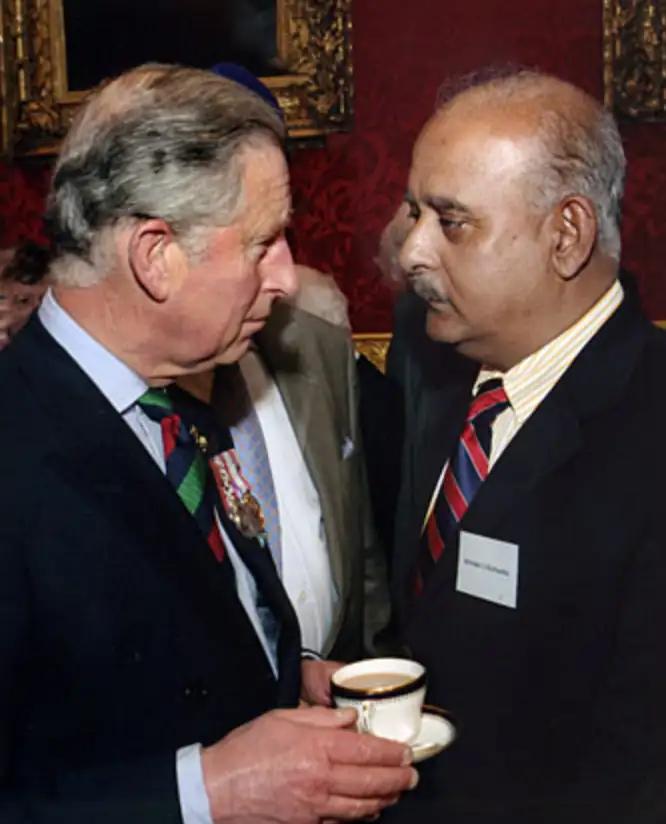
Dr Birinder Singh Ahluwalia is no run-of-the-mill Sikh leader in a multitude of ways.
To begin with, he is one of many amongst us who no longer wear the articles of faith, and therefore does not stand out as a Sikh like, say, amritdhari Sikhs do. He does not compensate, however, by feigning piety, nor does he offer any excuses for being the way he is.
But as I have got to know him through the years, I' ve discovered that in many crucial ways, he is more a Sikh in his heart, mind and soul than most leaders and luminaries I know (or know of) in the community — including those who claim a status, any status, on the sole strength of their external identity.
I learnt a long time ago by working closely within the Jewish community — my first stint as a lawyer was in Canada's largest Jewish law firm where I was hired as the only non-Jewish lawyer amongst more than a hundred legal eagles! — that every faith group consists of a wide spectrum of believers, ranging from one extreme to the other. And merely sitting at one end or the other, or anywhere between, does not in itself make you more pious or better or a more qualified member, or in any way entitled to plaudits.
That is, those who are exemplary as leaders, and are true community builders, can be found at every gradation of piety or religiosity.
And Birinder is a walking example of this within our community. I don' t know of a Sikh of any ilk who has done more for his community — in a positive, constructive, meaningful and effective way — than this man.
Take it with a pinch of salt, if you will, given my close association with him, and hence the presumption of bias. But, let me assure you to the extent I can, that what I have to say of him is sincere and offered with all the objectivity I can muster. Even though my proximity to him entitles me to address him by his first name and with an air of familiarity.
Birinder's journey began in Amritsar, Punjab, where he obtained his medical degree and was still pursuing his higher studies when he married and moved to Canada shortly thereafter.
He seldom talks about his wedding which took place in the first few days of June in Chandigarh.
The year was 1984.
After a rushed ceremony, the doli (newly wed couple) and baraat (marriage party) had to rush home to Amritsar, having received word that the city, nay, the state of Punjab was being clamped down in an indefinite curfew. The entire marriage party managed to reach Birinder's parents' home where they were forced to camp within relatively cramped quarters for the next week and more.
They then knew little of what was behind the full-scale battle that appeared to be raging in the distance, in the direction of the Darbar Sahib, with the sky lit up by incessant bombardment, the air rent with the staccato sounds of war.
Birinder headed abroad for higher studies and, after checking out several countries in Europe, settled on Canada.
His marriage did not survive the transition for long. He and his wife parted ways, but not before a daughter was born.
Before long, as he embarked on a career in the medical field, Birinder also took on the role of a single parent — something, I might add, that is close to my heart since I too followed a similar trajectory in my own life.
He's remarried since and he and his loving wife now dote on three wonderful daughters. But vis-à-vis family, he guards his privacy zealously.
His public life has also had its fair share of twists and turns. A number of windfalls, fuelled by the usual hurdles and challenges, took him in an unexpected direction. He flowed with the current, embracing opportunities and glossing over setbacks and deftly stepping around mine-fields'
He trained in the field of Diagnostic Imaging, and one by one, opened a series of clinics in the Toronto area. Today, he is the owner of one of the largest and most successful private medical diagnostic clinics in Canada.
Despite the phenomenal success he has experienced both professionally and financially, he remains focused on his work, still the kingpin of the busy operation which employs dozens of immigrant professionals from a score of different countries around the world. Thus, he has had hands-on involvement, personally, with close to a million patients to date, and in over three million diagnostic procedures during the same period which spans two decades.
Having had to deal with difficulties of his own as a young doctor in the West, once struggling to even get his otherwise impeccable qualifications recognized, he empathizes with the continuing waves of newcomers who find themselves against the wall of bigotry and protectionism. They've found in him a kindred spirit who offers them professional refuge and guides them into meaningful careers.
You walk into his office and it is a virtual United Nations, reflecting Canada like few of its institutions, sadly, do even today.
I have observed Birinder interacting with his employees, both at work and leisure. He treats them like family and they reciprocate by offering their unqualified loyalty and helping build a uniquely run institution.
Regardless of where he is in the world — either with family or on business or on community projects — he maintains an umbilical cord with his clinics. Seven days a week, no matter where he has struck camp, he receives a report on every procedure carried out in the clinics, and personally scrutinizes all the data and every analysis. It is his personal imprint that makes his operations the magnet for doctors and specialists throughout the region who seek reliable information on their patients.
As I' ve said elsewhere within this very series, it is what one does in addition to all of this that impresses me the most.
He lives well — an ideal which we as Sikhs aspire to, as part of our way of life. He wears his affluence well, in a classy but understated way.
He is soft-spoken. Never quick to judgement. He listens, and says little. When he does, his words are well-thought out, and weighed with wisdom. He's a diplomat and reconciler. He avoids conflict, but when confronted by it, he removes its rough edges with an aplomb which I' ve seldom seen with others. He's compassionate. He's forgiving. He's generous.
I remember when I was once acting for him as his attorney — yes, we began our acquaintance in an attorney-client relationship — in a litigious matter. During the course of a disposition — a formal process during which you get to cross-examine the adversary while the exchange is being recorded as part of a formal and legal proceeding — I managed to get the opponent to unwittingly admit that he had indeed defrauded Birinder.
The opponent's case had suddenly collapsed; we had won!
As Birinder and I sat in the waiting area while the opponent and his lawyer nursed their wounds in another room, I summed up the situation to Birinder: we would be receiving the full amount we had claimed, plus all our legal costs.
Birinder was quiet for a while. Then, he instructed me to speak to the opposing lawyer forthwith and offer his adversary a break of $10,000 from the amount owed.
"Why," I asked, "we' ve won" hands down!"
"Yes, we have," Birinder replied. "But I don' t want him to go home feeling an absolute loser!"
That's when I learnt about magnanimity in victory.
Then there was the other time when I had negotiated the purchase of a property for Birinder. The deal was made, the offer signed and counter-signed.
At that point, Birinder asked me to add $5000 to the price we had negotiated to purchase the property.
"Why?" I demanded, proud of having beaten down the price to one favourable to Birinder.
"No reason," Birinder replied. "I just want them to feel good about the deal!"
That's when I learnt about the magic of creating a win-win in everything you do.
Birinder is content with life, satisfied with all the gifts he enjoys. He takes time to smell the flowers, and refuses to be pulled into the rat-race.
There are many I know who have at least some, if not most, of these qualities. But few who then turn around and ask themselves. "How can I give back?"
This brings me to my pet peeve that I' ve nursed and campaigned against for 30 years and more: The lost art of giving to the community without demanding a benefit or reward in return.
'ÃÂÃÂÃÂÃÂÃÂÃÂÃÂÃÂGiving' , in its purest sense, is what Birinder does. Unsolicited. Free. Expecting no returns.
Not long after we had established a healthy attorney-client relationship, we were meeting one morning over breakfast to discuss business. Once we were past shop-talk, Birinder broached something we' d never talked about before — my extra-curricular activities.
He said he' d followed my op-ed columns in The Toronto Star and my commentary on the CBC, and was aware of all the community projects I was involved in. He then added that he liked what I was doing.
"If you embark on any new project and need help, let me know. I' ll be glad to assist," he said.
"Anything new you' re working on?" he asked when I didn' t say anything, not sure if I wanted to change the nature of our relationship.
"There's always stuff, new stuff, that I want to do," I murmured.
"Good. Tell me about one," he said.
So, I told him about my dream of starting a Sikh film festival. I rattled on for a few minutes. He didn' t interrupt me.
When I finally stopped, Birinder was quiet for a while. I chided myself: had I crossed the line?
He spoke. "How much would it cost, this project?"
I gave him a rough estimate, off the top of my head.
"How much would it need to start? And then, how much, at what intervals?"
I told him.
He sipped his coffee for a while.
Then, he put his hand inside his pocket, pulled out a cheque book, and began filling out a cheque.
He then handed it to me for the full amount of the seed money I had said the project would need to launch it. "Let me know when you need more," is all he said.
That is how The Spinning Wheel Film Festival was born. Though it would take another four months before its inaugural launch, it had taken no more than 20 minutes after he had asked me if I needed help with any new project, for my dream to crystallize.
The rest is history.
Today, Sikh film festivals have sprung up all over the world. And many more under the rubric of "Punjabi' . And 'South Asian', ' Indian' , etc.
The Spinning Wheel, singled-handedly, started a world-wide movement.
Birinder was also involved hands-on in starting a local chapter of the Sikh film festival in New York. Then, another in California. Both continue today, though under new names, having been guided by, inter alia, Birinder personally and on site during the initial years. [The one in New York now goes
by the name, "Sikh International Film Festival"; the one in Los Angeles under the title, "Sikh Lens — Sikh Arts & Film Festival."]
There were others that sprang up, inspired by the seed planted by Birinder that morning. One in Washington, D.C. One in Florida. Sikhnet.com started one as a youth online film festival. And so on and so forth
If you' re wondering, sikhchic.com too began similarly, the seed planted by Birinder as well. He helps nurture it to this very day ... but, with his usual panache, remains hands-off and does not participate in its editorial policy or day-to-day running to any degree.
I know of dozens, no, scores of other projects which have received health-giving injections from this man. I know of them, but not from Birinder. I hear about them from time to time, quite by chance, from third-parties.
The Khalsa School in Brampton. The world-famous Hospital for Sick Children in downtown Toronto. Gurdwaras. Hindu temples. Christian churches. Muslim mosques. Sports teams. Cultural associations. Women's support centres. Struggling writers, artists, journalists, filmmakers. Victims' groups ... Here in North America, and as far away as Punjab and India.
No doubt, many others do this, and some do far bigger and grander things.
Here's the difference with Birinder, though.
More often than not, he offers help even before it is sought. If he reads in the media of a group in distress, he calls and says, can I help.
And, he doesn't ask if one has a tax-deductible status or a charity designation. That is, he doesn' t make a tax-deductible receipt a pre-requisite.
[I don' t mean to suggest there's anything wrong with it. It serves a purpose. But the point I' ve been trying to make for decades is that public giving cannot be allowed to be hijacked by corporate quid-pro-quo considerations: it threatens to demean, sometimes even prostitute, an otherwise noble idea.]
Birinder has no desire to sit on boards and committees. He gives and he moves on. He does not demand that he or his friends or relatives then be made executive or board members, so that he can then extract a benefit or satisfaction.
He's been invited to join and has accompanied the Prime Minister of Canada, for example, as part of a team to boost trade in foreign lands. He takes interest in current world affairs and is consulted by politicians of every party.
He supports gurdwara projects but refuses to sit on their decision-making bodies. As a result, he's never in conflict with any one gurdwara, never feeling the need to hop over to another, or to start a new one.
He sends out no press releases. Holds no press conferences. Lords over no foundations. Never touts himself as a leader, or brags about firsts or of being the fount of big and grand projects.
He's a doer, not a talker or a bragger or a publicity hound.
To sum a rich and full life, in a few words: Birinder is a man with ideas, and a man who gets things done. He has a brain and a heart and a soul.
And street smarts.
Dr Birinder Singh Ahluwalia is an extraordinary man in every sense of the word ... a true asset of our worldwide community.
I hope and pray that we are blessed with leaders who are made of such mettle.
For earlier postings on The Extraordinaries, please go to the
DAILY FIX
Section of sikhchic.com.
September 22, 2014